
As part of the government’s efforts to enhance service quality and re-engineer processes…
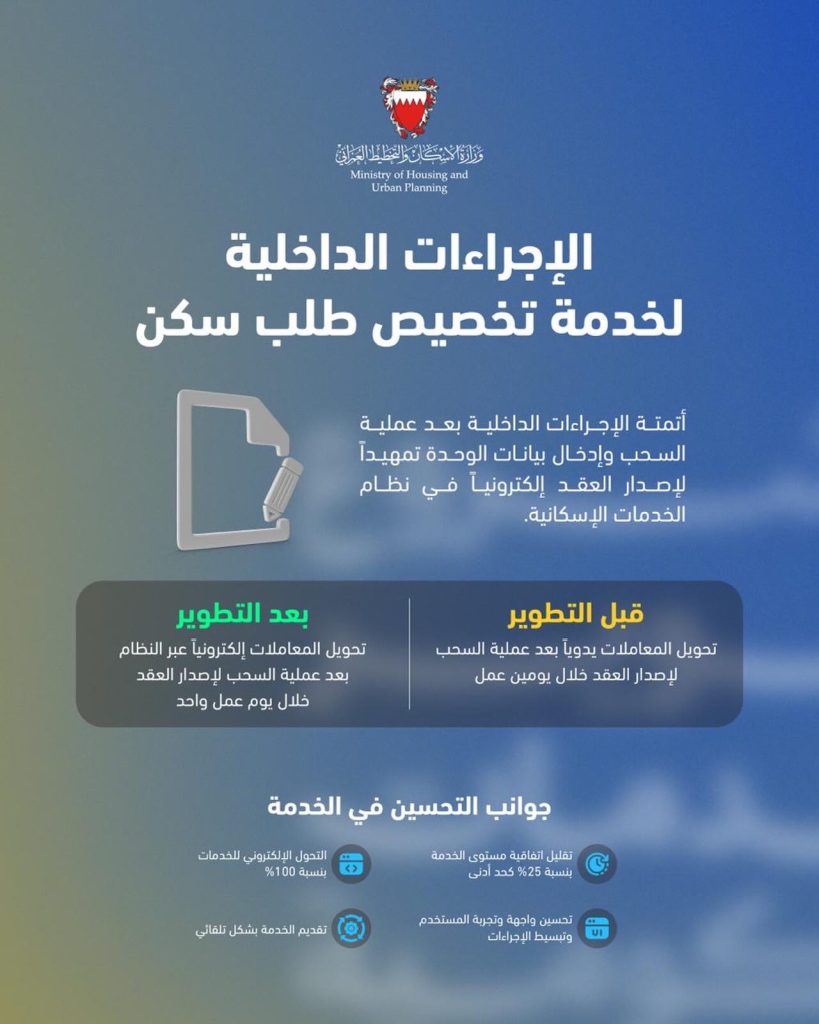
As part of the government’s ongoing efforts to improve and re-engineer the quality of services, the Ministry of Housing and Urban Planning has developed the “Housing Request Allocation” service by converting it into a fully automated “internal” digital procedure, which immediately precedes the electronic contract issuance service, with the aim of improving customer experience, speeding up the completion of transactions, and raising the efficiency and quality of services provided.
Under the improved service, operational efficiency has been increased by reducing the transaction completion time from two days to just one working day. The development process is based on the complete automation of the procedural path at a rate of 100%. Once the electronic draw for the housing unit or plot is completed, the system automatically links the address to the citizen’s request to issue the contract electronically without the need for paper transactions, which enhances the speed and accuracy of government performance.
In this context, Her Excellency Ms. Amna bint Ahmed Al Rumaihi, Minister of Housing and Urban Planning, affirmed that this development aims to simplify the user journey by reducing the steps of internal procedures, thus saving time and effort for beneficiaries. The re-engineering of this procedure also contributed to reducing the required documents by 50% and lowering the necessary approvals by 25%, which serves the aspirations for quality and transparency in housing performance.
This organizational improvement comes as an integrated technical step that begins immediately after the completion of the electronic draw process, to be linked internally to the housing services system up to the issuance and documentation of the contract, where all operations are carried out through the technically linked systems.
As part of ongoing government efforts to develop and re-engineer government services, more than 1,300 government services have been documented, translated, and published, with around 800 services undergoing development and re-engineering across various government sectors, This is based on proposals and feedback received regarding government services through the National System for Suggestions and Complaints “Tawasul,” investor feedback, and secret shopper reports evaluating government services, as well as the launch of guidance manuals and service level agreements, These efforts contribute to improving procedural efficiency, enhancing service quality, strengthening beneficiary experience, and supporting the government’s digital transformation journey.