
As part of the government’s efforts to enhance service quality and re-engineer processes…
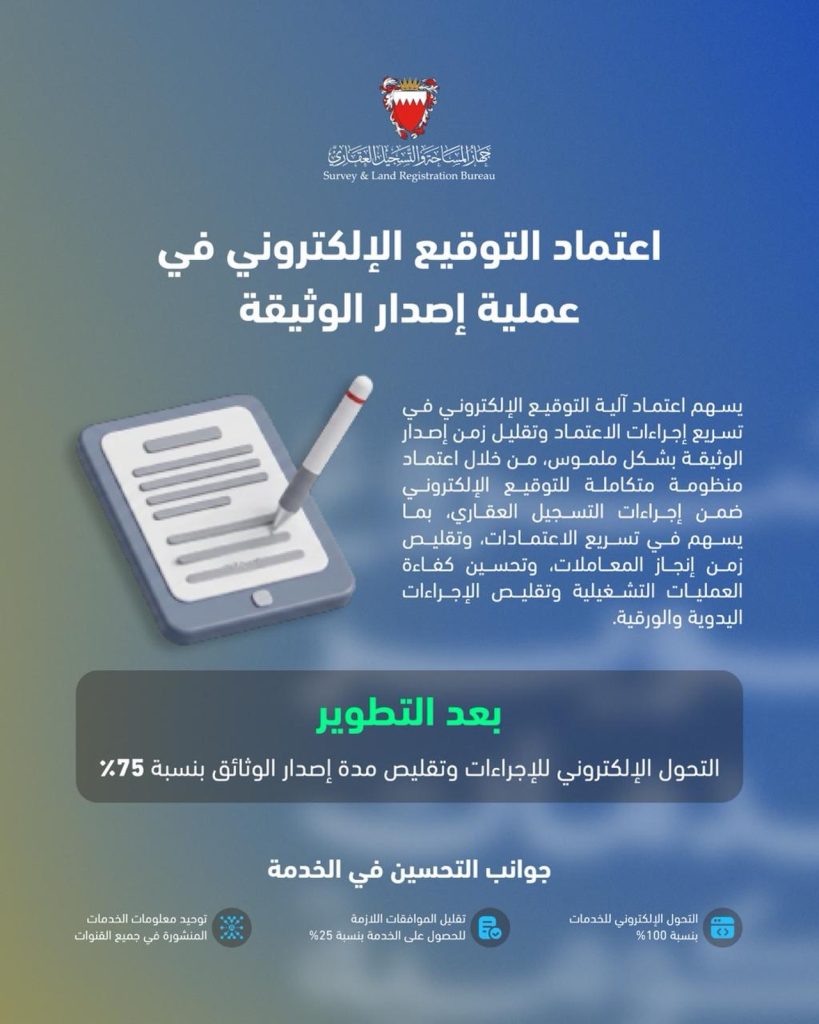
As part of the government’s ongoing efforts to improve and re-engineer the quality of services, the Survey and Land Registration Bureau has developed the document issuance signing service to become fully electronic, as a new digital procedure within a package of continuous improvements aimed at speeding up procedures, reducing document issuance time, and improving the efficiency of operational processes, in line with the government’s digital transformation objectives and enhancing the beneficiaries’ experience.
Under the improved service, the signing and approval procedures have been automated, reducing the time required for approval by 75% and eliminating paper and manual procedures related to signing, through its full implementation within the electronic system for real estate registration workflow, in a step that reflects an internal improvement that directly impacts the speed of the service provided.
In this context, His Excellency Engineer Basim bin Yaqoub Al-Hamar, Head of the Survey and Land Registration Bureau, affirmed that this service comes within the framework of the Bureau’s adoption of innovative digital solutions that enhance the efficiency of achievement, improve the quality of services, and support digital transformation, noting that this procedure falls within a path that focuses on simplifying procedures, reducing requirements, and raising the efficiency of government services in line with national trends in digital transformation.
His Excellency pointed out that the agency works according to a continuous methodology for developing government services, which is based on reducing the number of steps and required documents, unifying application procedures, and fully transitioning to electronic channels, in order to ensure the provision of faster, clearer and easier services, and to enhance the effectiveness of the work system and raise the efficiency of institutional performance.
He added that this step will contribute to expediting transactions, reducing the need for in-person visits, enhancing transparency, and enabling electronic tracking of applications. He pointed out that adopting electronic signatures represents an advanced stage in the development of real estate documents, as the service has moved from a traditional model relying on multiple manual procedures to a fully integrated digital model that allows for automated and seamless execution of procedures, thus enhancing speed of completion and raising the level of accuracy and reliability. He also explained that the electronic signature is certified and protected by security and encryption methods that ensure data integrity and document validity, guaranteeing reliability.
Al-Hamr said that the electronic ownership document has witnessed a series of developments and improvements over the past years in response to the aspirations of beneficiaries, including simplifying procedures, reducing requirements, and enhancing integration between systems, leading to the adoption of the electronic signature as a final automated stage within the path of integrated digital transformation.
As part of ongoing government efforts to develop and re-engineer government services, more than 1,300 government services have been documented, translated, and published, with around 800 services undergoing development and re-engineering across various government sectors, This is based on proposals and feedback received regarding government services through the National System for Suggestions and Complaints “Tawasul,” investor feedback, and secret shopper reports evaluating government services, as well as the launch of guidance manuals and service level agreements, These efforts contribute to improving procedural efficiency, enhancing service quality, strengthening beneficiary experience, and supporting the government’s digital transformation journey.